You’ll never walk alone: Inter-pedestrian distance, eHMIs, and crossing decisions in virtual reality
Alam, M. S., Dey, D., Martens, M., Bazilinskyy, P.
Submitted for publication. (2025)
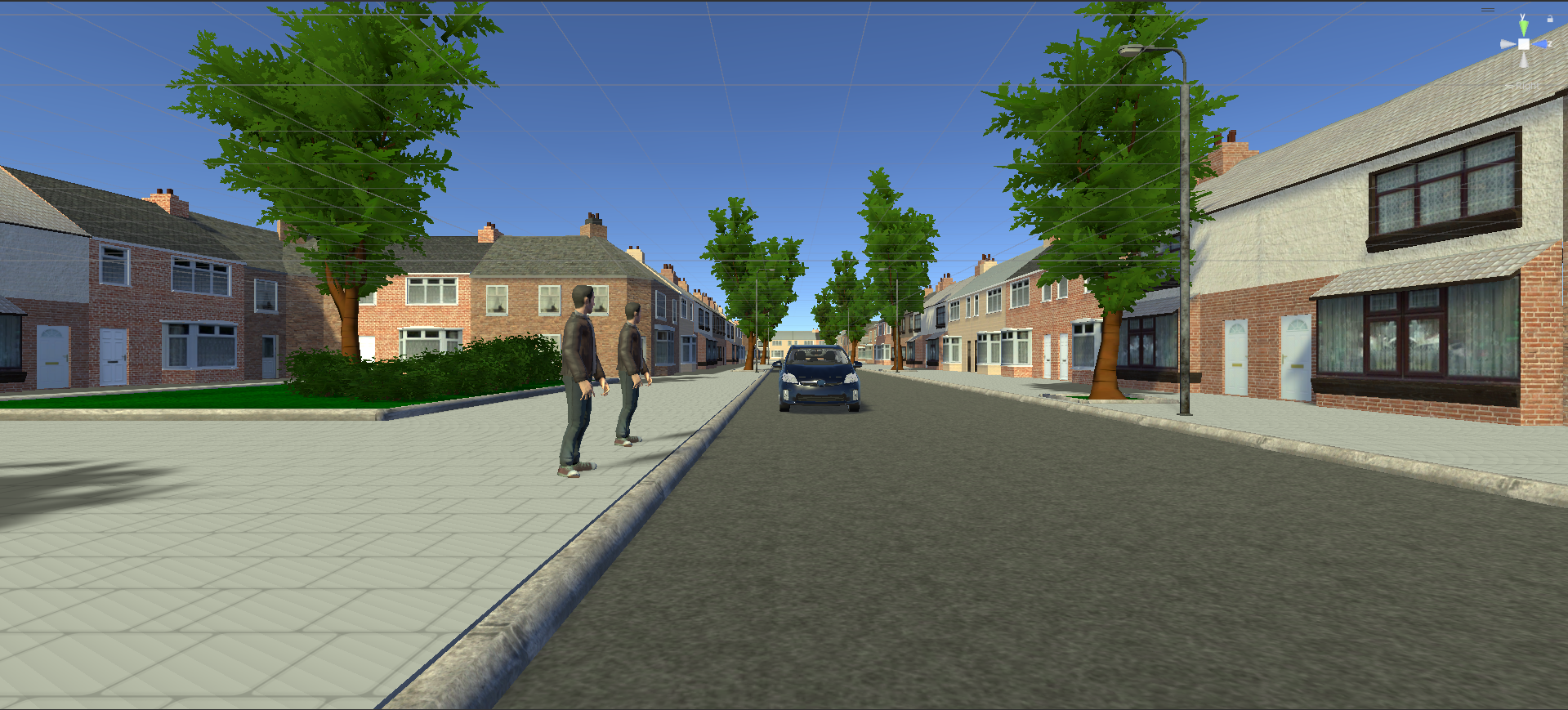
ABSTRACT Traffic interactions rarely happen in sanitised, one-on-one, dyadic settings, and automated vehicles (AVs) are no exception: they will encounter pedestrians not only walking alone, but also in groups or scattered co-located individuals. However, AV-pedestrian research rarely considers this social context. We conducted a virtual reality (VR) study (N = 50) to examine how a co-located pedestrian and an external Human–Machine Interface (eHMI) shape perceived crossing safety. The participants stood at the kerb alongside a second pedestrian while an AV approached. In a within-subjects design we varied vehicle yielding (yielding vs. non-yielding), eHMI (off vs. on), inter-pedestrian distance (2--10~m, 2~m increments) and whether the other pedestrian stood in front of the participant, facing the oncoming AV, or behind them. Participants held a controller trigger whenever crossing felt unsafe and later rated how much the other pedestrian and the inter-pedestrian distance influenced their crossing decision. The perceived crossing risk was substantially lower for yielding than non-yielding AVs, with an active eHMI further reducing risk in yielding trials. Distance-influence ratings were modest but strongly depended on visibility. The correlations between perceived risk and distance influence were small and negative, indicating that vehicle behaviour dominated safety judgments, while social spacing primarily shaped subjective impressions. These findings suggest that, while clear AV yielding cues (including eHMIs) should remain the primary focus for supporting pedestrian safety, AV evaluation and interface design should also account for co-located pedestrians and their visibility, as these factors can shape pedestrians' perceptions and decision-making in realistic street-crossing contexts.