Perceived Crossing Risk in Multipedestrian Encounters with Automated Vehicles: Effects of Yielding, eHMIs, and Pedestrian Position
Alam, M. S., Dey, D., Martens, M., Bazilinskyy, P.
In preparation.
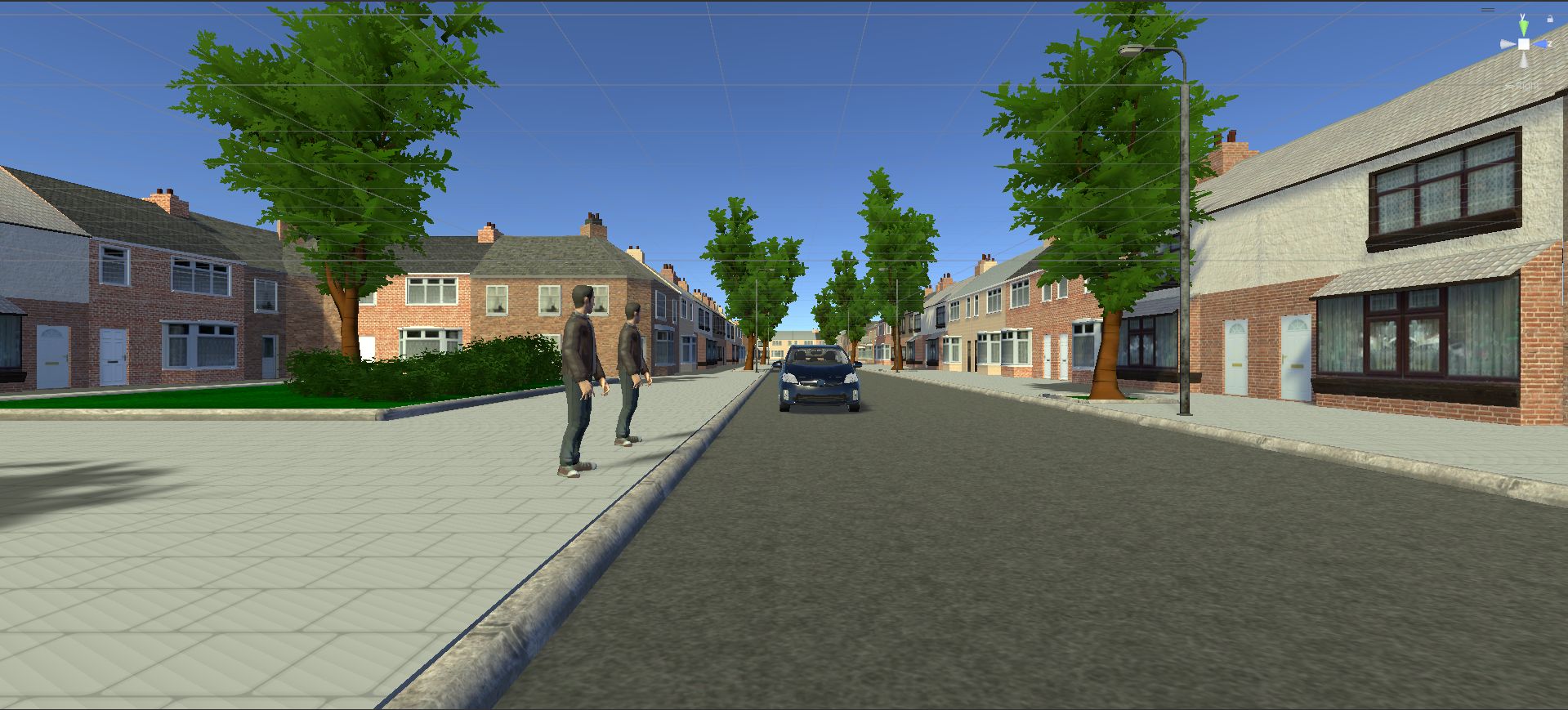
ABSTRACT This virtual reality study examined how pedestrian spacing and relative position influence perceived crossing risk during encounters with an automated vehicle. Fifty participants completed a within participant experiment varying vehicle yielding, conditional external Human-Machine Interface (eHMI) logic, relative pedestrian order, and five spacings from 2 to 10~m. Participants pressed a controller trigger whenever they judged that initiating a crossing would be unsafe. The primary outcome was the percentage of a fixed five second interval before vehicle passage classified as unsafe. A participant clustered marginal binomial model showed that yielding reduced predicted perceived unsafety by 38.71--52.66 percentage points across the four eHMI and order contexts, with Holm adjusted p<0.001 throughout. Conditional eHMI logic reduced perceived unsafety by 9.30 points in yielding trials where the participant was first in the vehicle's path (95% CI [-14.85,-3.75], adjusted p=0.004). A 2,000 sample participant bootstrap supported this contrast (95% percentile interval [-15.31,-4.25]) and all four yielding contrasts. No statistically reliable eHMI effect was found in either non-yielding order condition or in the yielding trials where the avatar was first. Complete model repetitions at trigger thresholds of 0.05, 0.10, and 0.50 produced the same substantive conclusions. Analyses that held participant position constant or aligned data to vehicle events did not support a consistent independent spacing effect. For pedestrian safety assessment, yielding kinematics remain the dominant cue, and any eHMI benefit should be evaluated across multipedestrian geometries rather than assumed to generalise across crossing contexts.