Trial ordering in repeated exposure virtual reality pedestrian research: comparing fixed and participant specific randomised sequences
In preparation.
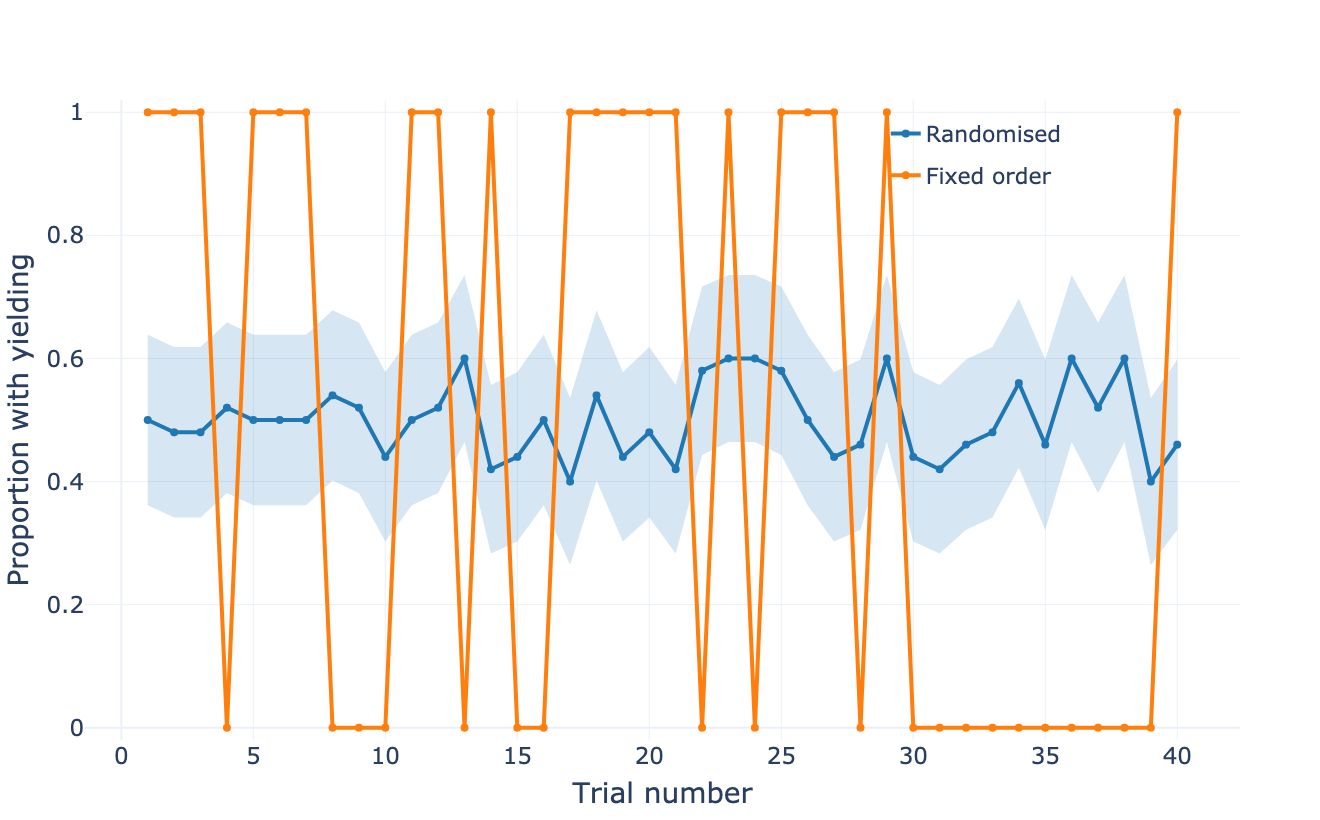
ABSTRACT When every participant receives the same trial sequence, each condition is tied to one trial position and preceding experience. We compared two non concurrent runs of a virtual reality pedestrian interaction experiment. Participants were not assigned at random to study run. Fifty participants received participant specific randomised sequences and 50 received one fixed sequence of the same 40 trials. The main measure was the percentage of 100 ms prepassage intervals in which a trigger indicated perceived crossing unsafety. The estimate was 40.48% in the randomised run and 42.82% in the fixed run, a difference of 2.34 percentage points (95% CI [-5.16, 9.83], p=0.54). The confidence interval did not establish equivalence. No reliable overall differences were detected for additional trigger or head movement measures, although condition response profiles differed for several outcomes. The strongest condition specific contrast concerned the perceived influence of pedestrian spacing in a yielding, eHMI off, participant second, 2 m condition. The fixed run was 23.34 rating points lower (globally adjusted p=0.011), and this condition always occurred first in the fixed sequence. Its effect could not be separated from early session experience or sample differences. In the randomised run, the estimated eHMI contribution to reported vehicle intention understanding increased with trial position and prior relevant exposure, but these changes did not differ reliably between runs. Confounding of scheduling with study run precludes causal attribution, but the comparison demonstrates why fixed sequences weaken the interpretation of condition specific and experience related effects.